
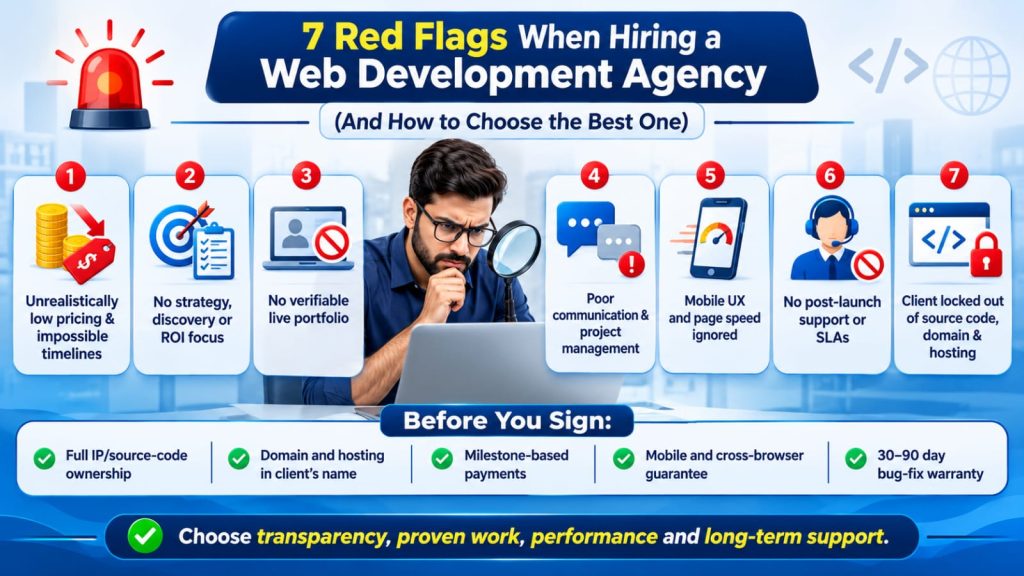
7 Red Flags to Watch Out for When Hiring a Web Development Agency (And How to Choose the Best One)
Over the past decade of auditing broken codebases, rescuing stalled projects, and architecting digital platforms for growing enterprises, I have sat across the table from dozens of frustrated founders. Almost every single one of them started their journey the same way: they searched online for a web development company Kolkata, picked an agency that offered a fast timeline and a bargain price, and ended up with a sluggish, unscalable website that had to be rebuilt from scratch within twelve months. Whether you are a legacy enterprise in Park Street digitizing your supply chain, a fast-scaling startup in Salt Lake Sector V, or a retail brand expanding across Eastern India, your website is your primary revenue engine. Hiring the wrong business website development company does not just waste your initial budget—it costs you search rankings, customer trust, and months of lost market momentum. To help you filter out the noise and identify the best web development company for your commercial goals, here are 7 critical red flags you must watch out for before signing a single contract. 1. Unrealistically Low Pricing and “Too Good to Be True” Timelines In my ten-plus years in web engineering, the single most expensive mistake I have seen business owners make is selecting a vendor based solely on the lowest bid. If an agency quotes you ₹5,000 to ₹10,000 for a custom corporate portal or an e-commerce platform and promises delivery in four days, walk away immediately. Genuine custom web development requires stakeholder discovery, UI/UX wireframing, modular frontend and backend coding, API integrations, and multi-device quality assurance. 2. Zero Focus on Strategy, Discovery, or Commercial ROI Pay close attention to the questions an agency asks during your very first discovery call. Does their team jump straight into discussing color palettes, slider animations, and cheap hosting packages without asking about your customer acquisition cost, sales funnel, or target buyer personas? 3. A Lack of a Verifiable, Live Portfolio In the digital agency landscape, polished sales decks are easy to fabricate. Any freelancer or newly formed shop can purchase a slick agency template and claim they have built hundreds of complex web applications. 4. Opaque Communication and Disorganized Project Management Building a modern web application involves dozens of moving parts—wireframing, database schema design, frontend development, third-party API connections, and security testing. If communication feels chaotic during the sales process, it will become a nightmare once development begins. 5. Treating Mobile-First UX and Page Speed as an Afterthought More than 70% of internet users in India browse and transact primarily on smartphones, and Google evaluates your search rankings exclusively through mobile-first indexing. Moreover, modern buyers will abandon a slow page within three seconds. 6. No Post-Launch Support or Service Level Agreements (SLAs) Many founders view a website launch like the handover of a physical office—once the ribbon is cut, the work is finished. In reality, a website is a living software ecosystem that requires continuous security patches, server monitoring, database backups, and framework updates. 7. Locking You Out of Your Source Code, Domain, and Hosting This is the most predatory practice in the web industry, and I have personally helped numerous businesses rescue their digital assets from it. Some agencies build client sites on proprietary, closed-source CMS platforms or register the client’s domain name and cloud hosting under the agency’s corporate account. Low-Tier Vendor vs. The Best Web Development Company: Quick Comparison Before finalizing your shortlist, benchmark every candidate against this side-by-side matrix: Evaluation Criteria Low-Tier / Template Vendor Best Web Development Company Project Kickoff Starts coding immediately without strategy Conducts technical discovery, competitor audit & wireframing Codebase & Tech Stack Bloated pre-made themes & heavy plugins Clean, modular, scalable code (React, Next.js, Laravel, Custom WP) SEO & Speed Ignored until after launch Technical SEO, schema markup & Core Web Vitals built-in Project Management Ad-hoc emails/calls with unclear timelines Dedicated project manager, sprint milestones & staging previews Asset Ownership Restricted access or proprietary lock-in 100% client ownership of code, domain, and hosting accounts Post-Launch Care Disappears after final payment Structured warranty period & proactive maintenance SLAs 5-Point Contract Checklist Before You Sign Never transfer an advance deposit until your service agreement explicitly confirms these five protections: Ready to Build a High-Converting Website Without the Guesswork? Choosing the right business website development company comes down to transparency, proven engineering standards, and a genuine commitment to your bottom line. By watching out for these seven red flags and insisting on clear technical accountability, you protect your capital and set your brand up for sustainable digital growth. If you are planning a new website build or looking to overhaul an underperforming platform, connect with an experienced web development company Kolkata enterprises rely on for scalable, SEO-ready architecture. Explore tailored engineering solutions and request a consultation through ScriptWeb Solution to map out your project roadmap with confidence.